Module 4
Supervising Task-Oriented AI Agents and Everyday Workflows
🎯 Learning Objectives
After completing this module, you will be able to:
- Direct browser-based autonomous AI agents through multi-step administrative workflows
- Monitor agent execution steps to detect deviations, errors, and hallucinations
- Integrate AI task automation safely into daily office operational habits
Click Next → to begin.
Understanding Browser-Based AI Agents and Multi-Step Workflows
What Is a Task-Oriented AI Agent?
In standard conversational AI interactions, you provide a single prompt and receive a direct text response. A task-oriented AI agent, by contrast, is an augmented AI system designed to achieve a broader objective by planning, executing individual actions across multiple steps, and observing interim results without requiring constant manual prompts for each individual subtask.
In everyday workplace environments, knowledge workers encounter agents operating within standard web browser interfaces. Rather than merely answering a question, a browser-based agent might research three distinct vendor websites, compare pricing schedules, draft a structured evaluation memo, and prepare follow-up email drafts for review.
How Multi-Step Workflows Function
Agents execute multi-phase workflows through a continuous cycle of planning, action, and evaluation:
- Goal Interpretation: The agent examines your primary prompt, breaks down the broader objective, and outlines intermediate milestones.
- Action Execution: The agent performs individual operations, such as gathering information, analyzing uploaded tables, or drafting specific text segments.
- Environment Feedback: The model assesses intermediate results (known as ground truth) to determine whether the action succeeded or requires adjustment before proceeding.
[User Goal] ──> [Decompose Plan] ──> [Execute Step] ──> [Evaluate Result] ──> [Final Output]
                                           ▲                    │
                                           └──── (Iterate) ─────┘
Guided Workplace Scenario
Consider an administrative coordinator tasked with compiling an executive summary of four competitor public announcements.
- Single-prompt approach: You ask a conversational model to write an overview based on its stored memory, risking outdated figures or vague summaries.
- Agentic workflow approach: You direct a browser-based tool to sequentially inspect each announcement link, extract specific metrics (launch dates, product tiers, price adjustments), format those metrics into a comparison table, and draft an executive briefing.
Common Pitfalls and Clarifications
A frequent beginner misconception is assuming an AI agent possesses true autonomous reasoning or common sense. An agent does not "understand" office goals in human terms; it predicts sequential next actions based on pattern recognition. When an early step produces an error—such as misinterpreting a date on a vendor website—the agent will continue executing subsequent steps using that flawed data unless you intervene.
Understanding this execution cycle prepares you to oversee agent operations actively rather than treating automated tools as unattended background batch jobs.
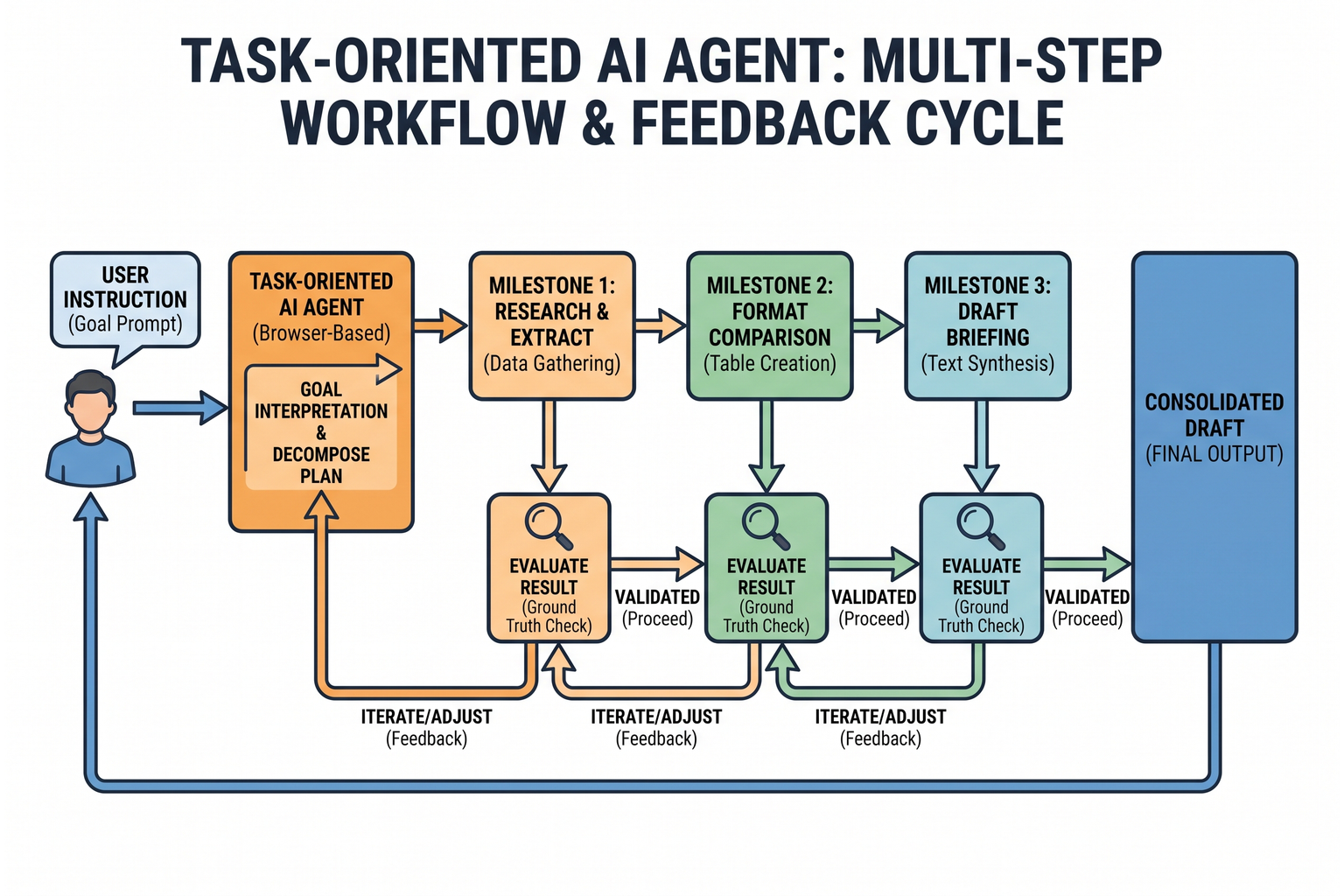
Diagram showing the multi-step cycle of an AI agent from goal input to decomposed milestones, execution, feedback, and final output.
💡 Key Takeaways
- Task-oriented AI agents decompose broad objectives into sequential actions using browser tools.
- Agentic workflows rely on iterative cycles of planning, executing steps, and assessing interim results.
- Agents do not possess human judgment; errors in early stages propagate into later milestones unless supervised.
Supervision Strategies and Maintaining Human Oversight
The Principle of Human-in-the-Loop Supervision
Human-in-the-loop (HITL) supervision is an operational safeguard where a human reviewer retains ultimate authority over an automated system's decisions, validations, and final releases. When delegating complex tasks to browser-based AI agents, you act as the executive supervisor rather than a passive bystander.
Supervision is critical because autonomous agents can encounter execution drift, where the model strays from your initial scope, or hallucination compounding, where an early factual error becomes accepted ground truth for all subsequent operational steps.
Checkpointing: Breaking Workflows into Validation Gates
The most effective supervision technique for knowledge workers is checkpointing. Checkpointing means instructing the agent to pause at defined milestones so you can inspect interim outputs before authorizing further work.
- Planning Checkpoint: Direct the agent to generate and display its proposed task outline. Confirm that the planned subtasks match your business intent before allowing execution.
- Data Verification Checkpoint: Review extracted facts, source figures, or synthesized notes before the agent begins drafting external-facing content.
- Final Release Checkpoint: Verify the completed deliverable for tone, policy compliance, and factual accuracy before sending or publishing.
Guided Walkthrough: Supervising a Multi-Step Task
Imagine you are directing an agent in a browser window to draft an event coordination plan:
- Initiation: Enter the command: "Propose a four-step plan to organize catering quotes, schedule setup times, and prepare attendee confirmation templates. Pause after the plan and wait for my approval."
- Intervention: The agent proposes searching external catering menus, but your office has preferred internal vendors. You intervene: "Revise step 1 to use only the vendor rate sheet provided in my attachment."
- Validation: The agent adjusts its plan, extracts the rates, and pauses for your confirmation before drafting the schedules.
Common Mistakes to Avoid
A critical mistake is providing an open-ended prompt such as "Research this topic, create slides, and email the department heads." Completely removing human validation gates across administrative tasks creates severe compliance and data-integrity risks. Always require the agent to stop prior to irreversible actions, such as sending emails, overwriting documents, or publishing public records.
In the next lesson, you will learn how to turn these supervision checkpoints into sustainable everyday habits.
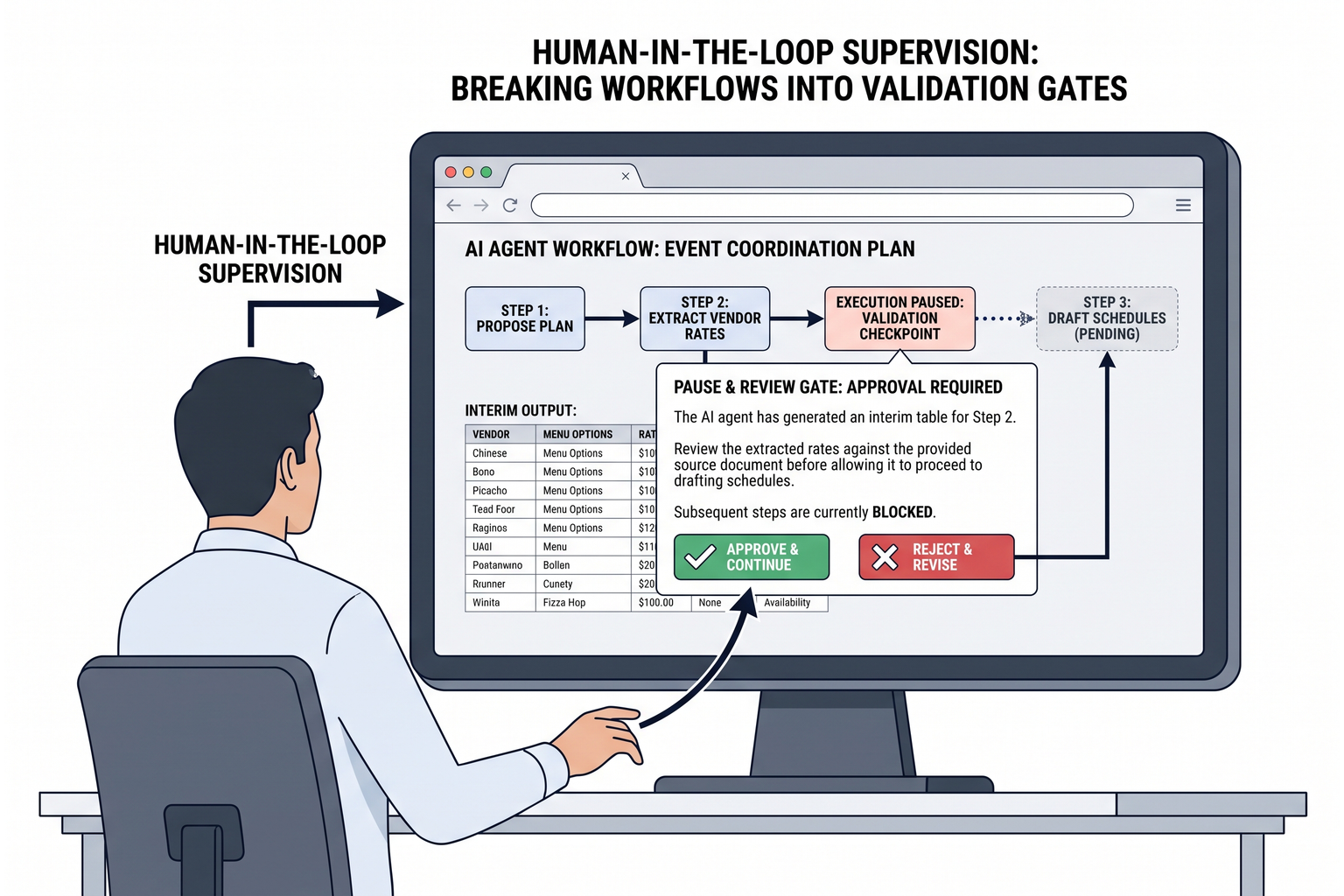
Illustration of a supervisor review checkpoint showing an agent pausing execution with an interactive approval dialog.
💡 Key Takeaways
- Human-in-the-loop supervision keeps knowledge workers in control of critical decisions and final deliverables.
- Checkpointing divides multi-step agent actions into explicit validation gates to prevent error compounding.
- Never permit an AI agent to execute irreversible actions without explicit human approval.
Integrate AI Task Automation Safely Into Daily Office Operational Habits
Establishing Responsible Automation Habits
Adopting AI agents into daily business workflows requires building disciplined personal habits. While conversational tools offer rapid output, sustainable workplace adoption depends on maintaining confidentiality, safeguarding organizational data, and setting clear boundaries on which tasks to automate.
Before delegating routine tasks, apply the Rule of Proportional Autonomy: grant an AI agent autonomy proportional to the task's reversibility and risk. Low-risk, reversible tasks (such as sorting raw meeting notes or drafting internal outlines) require minimal friction, while high-risk tasks (such as processing client communications or handling budget figures) demand stringent supervisory checkpoints.
Three Core Habits for Daily Workflow Integration
To safely incorporate browser-based AI into administrative routines, practice these foundational habits:
- Data Sanitization Before Delegation: Never input personally identifiable information (PII), proprietary financial balances, non-public intellectual property, or confidential credentials into web-based AI tools. Use placeholder values (such as
[Client A]or[Budget Amount]) during drafting. - Explicit Handoff Prompts: Treat task assignment like onboarding a capable assistant on their first day. Define the deliverable format, role constraints, and boundaries explicitly, stating what the tool must not do.
- Independent Output Verification: Never accept calculated metrics, policy references, or dates generated across multi-step runs without cross-checking the primary source documents.
[Raw Work Intake] ──> [Sanitize Data & Set Boundaries] ──> [Supervised Agent Execution] ──> [Independent Verification] ──> [Final Approval]
Workplace Scenario: Daily Schedule and Meeting Synthesis
Consider an administrative coordinator who manages weekly status updates across three project teams:
- Unsafe Practice: Copying entire unfiltered email threads containing employee personal contact details into a browser-based AI tool and asking it to broadcast summaries to all staff.
- Disciplined Habit: The coordinator strips personal contact details, provides the bulleted status items with clear role prompts, instructs the tool to produce a draft table, reviews the summary against team milestones, and manually distributes the finalized document.
Common Misconception
A frequent misconception is that integrating AI means automating entire end-to-end jobs. In practice, successful knowledge workers automate phases of tasks—drafting, organizing, or formatting—while preserving human judgment for strategic review and final communications.
Mastering these supervisory habits equips you to complete this module's hands-on lab exercise, where you will guide a multi-step administrative workflow through structured browser prompts.
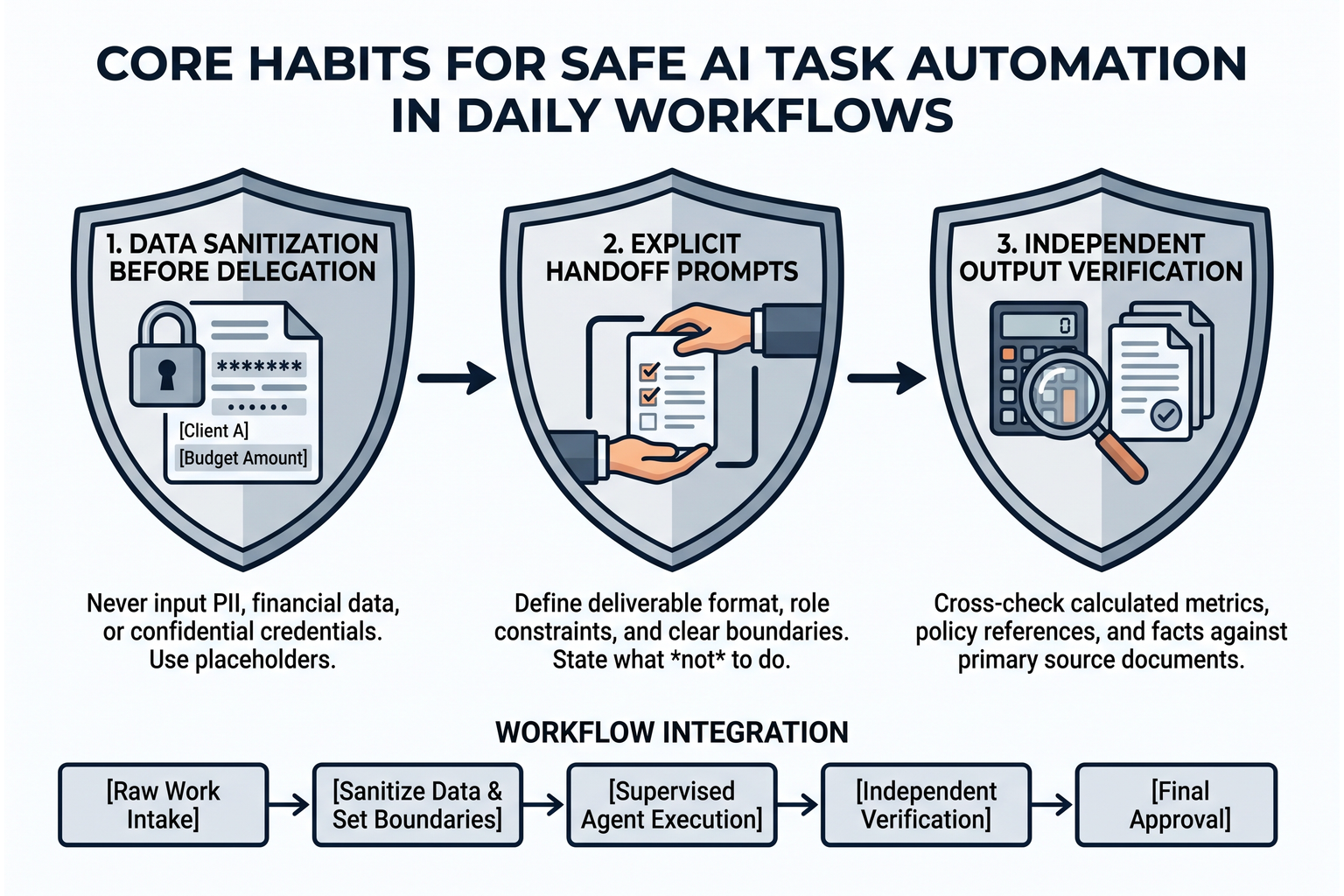
Infographic showing the three core habits of safe workplace AI integration: data sanitization, explicit handoffs, and independent verification.
💡 Key Takeaways
- The Rule of Proportional Autonomy matches agent oversight levels to the risk and reversibility of each task.
- Daily operational habits require sanitizing sensitive data before prompting and verifying deliverables independently.
- Effective AI integration focuses on automating bounded task phases rather than unmonitored end-to-end workflows.
🔬 Directing a Multi-Step Administrative Workflow with AI
Objective: Execute a supervised multi-step administrative task using free browser-based AI tools, validating progress and correcting errors.
- Access to a modern web browser (such as Google Chrome, Mozilla Firefox, Microsoft Edge, or Apple Safari).
- An active, free consumer account on at least one approved AI platform: ChatGPT (chatgpt.com), Claude (claude.ai), or Gemini (gemini.google.com).
- No local software installations, administrative privileges, paid tiers, or API keys are required.
- All scenario data is synthetic workplace text created within this exercise; do not use real personal or confidential company information.
Procedures
Navigate to the web address for your chosen tool in your browser:
- ChatGPT:
https://chatgpt.com - Claude:
https://claude.ai - Gemini:
https://gemini.google.com
Ensure you are logged into your free account. Click New Chat (or the platform equivalent) to guarantee that prior conversational history or custom system instructions do not influence this administrative workflow.
A blank conversation window with an empty prompt input box ready for initial input.Copy and paste the following prompt into the chat box, replacing [learnerInitials] with your actual initials (e.g., nt):
You are an administrative operations assistant. We need to organize an internal quarterly team review meeting for Project [learnerInitials]-Ops.

Your task consists of three distinct phases:
Phase 1: Propose a 4-item preparation checklist and meeting agenda structure.
Phase 2: Extract attendee action items from raw meeting notes.
Phase 3: Draft a broadcast summary memo for team distribution.

CRITICAL SUPERVISION CONSTRAINT: Present ONLY the Phase 1 checklist and agenda structure now. Do NOT proceed to Phase 2 or Phase 3. Stop and explicitly request my review and approval before taking any further action.
Send the message.
A response containing a 4-item checklist and agenda outline for Project [learnerInitials]-Ops, concluding with a clear pause asking for user confirmation to proceed.Review the proposed Phase 1 outline against business rules. As a supervisor, you notice the agenda does not include an explicit time allocation for budget reconciliation. Enter the following feedback prompt to enforce human oversight:
Checkpoint Feedback on Phase 1:
The checklist is approved with one adjustment: ensure Item 3 specifically allocates 15 minutes for 'Department Budget Reconciliation'.

Now proceed to Phase 2:
Here are the raw notes from our pre-planning session:
- Jordan Taylor: Will finalize slide deck by Thursday 3 PM, needs vendor quotes from Morgan.
- Morgan Vance: Has received 2 of 3 vendor quotes; waiting on Apex Logistics ($4,200 quote pending).
- Alex Chen: Reserving Conference Room B and testing video conference equipment.
- Note: Do NOT contact Apex Logistics directly yet; wait for official vendor portal update.

Please extract these into a structured table with columns: Assignee, Action Item, Due Date / Status, and Dependencies / Constraints.

CRITICAL SUPERVISION CONSTRAINT: Output ONLY the Phase 2 table. Stop and wait for my validation before drafting any memo.
Send the message.
An updated acknowledgment incorporating the budget revision, followed by a markdown table categorizing Jordan, Morgan, and Alex's action items, concluding with a pause asking for approval before Phase 3.Examine the generated table closely. Verify that the assistant maintained data fidelity:
- Check that Morgan's row mentions waiting for the portal update rather than instructing someone to call Apex Logistics.
- Confirm the synthetic amount ($4,200) was not rounded, altered, or attributed to the wrong vendor.
If the AI hallucinated external actions (e.g., suggesting an outreach email to Apex), prepare a correction. Otherwise, issue the authorization prompt for Phase 3:
Checkpoint Validation on Phase 2: Verified.

Proceed to Phase 3:
Using only the approved agenda from Phase 1 and the verified action table from Phase 2, draft a concise internal broadcast memo addressed to the 'Project [learnerInitials]-Ops Core Team'.

Constraints:
1. Tone must be professional and direct.
2. Include an explicit cautionary note under Next Steps: 'Do not contact Apex Logistics directly until vendor portal confirmation is received.'
3. Do not invent any additional attendees or unstated deadlines.
Send the message.
A complete, professional administrative memo addressed to 'Project [learnerInitials]-Ops Core Team' featuring the approved agenda, tabular action items, and the explicit Apex Logistics caution note.Perform a final supervisory review on the delivered memo against the initial requirements:
- Boundary check: Confirm no personal sensitive data or real company details were entered.
- Factual fidelity: Check that Jordan Taylor's deadline is Thursday 3 PM and the budget reconciliation item is present.
- Proportional autonomy check: Note how breaking execution across three validation gates prevented unmonitored errors from propagating.
Once reviewed, copy the final memo text to your personal notes or text editor if you wish to retain it, then close the chat window or click Delete Chat to restore your workspace.
A fully verified administrative communication deliverable produced through controlled, checkpointed AI agent execution.⚠️ Troubleshooting
The AI ignores the pause constraint in Step 2 and generates all three phases in a single long response.
Stop the generation immediately using the 'Stop' button in the interface. Send a corrective prompt: 'You violated the supervision constraint. Clear your response. Provide ONLY Phase 1 as requested, and wait for my explicit approval before continuing.'
The assistant hallucinates extra attendees (e.g., adding project managers or clients not in the raw notes).
Intervene at the Phase 2 checkpoint with a corrective directive: 'Revise the table. Remove all individuals not explicitly listed in my raw notes. Include only Jordan Taylor, Morgan Vance, and Alex Chen.'
The web browser interface displays a rate limit or session timeout error on the free tier.
Refresh the browser page. If the current model is temporarily throttled, wait 60 seconds or switch to an alternate free platform (ChatGPT, Claude, or Gemini) and restart the workflow.
📝 Knowledge Check
Test your understanding of the material covered in this module. Select the best answer for each question.
🎯 Module Summary
In this module, you explored how task-oriented AI agents plan and execute multi-step workflows within browser environments. You learned the critical importance of human-in-the-loop supervision and how to use checkpointing to catch errors before they compound. Finally, you examined practical workplace habits for safe integration, including data sanitization and applying proportional autonomy across routine office tasks.
Learning Objectives — Review
Module Complete!
You have completed all sections of this module.
🎓 Comprehensive Course Post-Assessment
Test your mastery across all four modules of AI Fundamentals for Knowledge Workers. Scoring 80% or higher unlocks your official verified Certificate of Completion.
📖 Course Glossary & Key Terms Appendix
This appendix compiles canonical terms, definitions, and technical acronyms taught across all modules of this course for reference, review, and study.
A
Agent Planning Cycle is the three-stage operational workflow of autonomous agents comprising: 1) Goal Decomposition, 2) Tool Invocation, and 3) Reflection/Error Correction.
Agentic AI vs. Generative AI is generative AI produces single-turn static content on demand, whereas Agentic AI executes goal-directed, multi-step actions across systems with feedback loops and state awareness.
Approval Checkpoint (Validation Gate) is a mandatory programmatic stop in an agent workflow where human confirmation is required before state-changing or high-consequence operations (e.g., sending emails, deleting files, financial transfers) proceed.
C
Chain-of-Thought (CoT) Prompting is prompting a model to break down complex reasoning problems into explicit step-by-step intermediate thoughts before providing a final answer.
Constraints & Guardrails is explicit negative rules and boundaries specified in a prompt (e.g., length limits, forbidden phrases, required formats) that restrict AI outputs to corporate standards.
Context Drift is the gradual degradation of response quality or loss of original prompt constraints that occurs when long multi-turn conversations exceed optimal attention spans.
Context Window is the finite number of tokens (words and sub-words) an LLM can retain and process across input prompts, conversation history, and output generation within a single session.
D
Data Cleaning is the systematic process of identifying, correcting, or removing inaccurate, duplicate, or improperly formatted records from a dataset before analysis or formula modeling.
Data Processing Agreement (DPA) is a legally binding contract between an organization and an AI vendor stipulating that customer prompt data will not be logged, reviewed by human contractors, or used for model training.
Data Redaction (Sanitization) is the mandatory operational practice of removing, anonymizing, or replacing confidential business names, financial records, and PII with generic placeholders prior to submitting AI queries.
Deterministic vs. Probabilistic Systems is deterministic software produces identical outputs for identical inputs (e.g., standard code or spreadsheets), whereas probabilistic LLMs output likelihood-weighted variations.
F
Few-Shot Prompting is a prompt engineering technique that includes one or more high-quality input-output examples directly inside the prompt to establish exact formatting and tone patterns.
Fine-Tuning is the process of further training a pre-trained base model on a specialized domain dataset to adapt its style, vocabulary, or task performance.
Formula Syntax Verification is the practice of prompting an LLM to explain the step-by-step logic, range boundaries, and error conditions of complex spreadsheet formulas before applying them to production workbooks.
G
Generative Artificial Intelligence (Generative AI) is computer systems powered by deep learning models that generate new text, code, imagery, or data patterns from natural language prompts rather than merely analyzing or classifying existing datasets.
Grounding is the practice of constraining model responses strictly to authoritative reference documents, verified databases, or explicitly provided context packets to eliminate hallucinations.
H
Hallucination is a generative AI phenomenon where a model produces plausible-sounding but factually false, unverified, or fabricated statements with high confidence.
Human-in-the-Loop (HITL) is a governance architecture requiring qualified human professionals to review, verify, and validate AI-generated outputs before they are acted upon or released into business operations.
I
Importance of Data Cleaning refers to the critical operational requirement of sanitizing, formatting, and deduplicating raw datasets prior to analysis to prevent inaccurate calculations, broken spreadsheet formulas, and AI hallucinations (the 'Garbage-In, Garbage-Out' principle).
Intellectual Property (IP) Safeguards is corporate policies and technical controls ensuring proprietary source code, internal business strategies, and patentable materials are never transmitted to public AI platforms.
K
Knowledge Worker refers to a professional whose primary job responsibilities involve acquiring, analyzing, creating, and communicating information, ideas, and decisions (such as analysts, project managers, technical writers, and operations leads) rather than manual physical labor.
L
Large Language Model (LLM) is a machine learning model trained on vast text corpora that predicts the statistically most probable next tokens in a sequence based on prompt context and attention mechanisms.
M
Model Bias is systematic errors, unfair stereotypes, or unrepresentative viewpoints embedded in AI outputs resulting from skewed historical training data or uncalibrated alignment tuning.
Multi-Turn Prompting is the iterative practice of refining, steering, and expanding AI outputs through sequential conversation turns rather than expecting perfection in a single prompt.
N
Next-Token Prediction is the core statistical mechanism of generative text models where probability distributions determine each sequential word or character sub-unit without internal subjective reasoning.
O
Over-Reliance Risk is the cognitive hazard of passively accepting AI-generated prose, code, or calculations without independent human critical scrutiny and verification.
P
Personally Identifiable Information (PII) is sensitive data that can identify an individual (e.g., social security numbers, medical records, client addresses) that must be redacted before sending prompts to external AI models.
Prompt Engineering is the disciplined practice of structuring, refining, and constraining natural language instructions to guide generative models toward accurate, consistent, and mission-aligned outputs.
Prompt Injection is a cybersecurity vulnerability where untrusted external text or user input overrides system instructions to manipulate model behavior or bypass safety guardrails.
R
RCTC Framework is a structured prompt architecture organizing instructions into four critical components: Role (persona), Context (background), Task (actionable deliverable), and Constraints (rules and limits).
ReAct Pattern (Reasoning and Acting) is an agent execution loop where the model explicitly generates a Thought (reasoning), executes an Action (tool call), and monitors the Observation (output) before deciding the next step.
Retrieval-Augmented Generation (RAG) is an architectural pattern that dynamically retrieves relevant document excerpts from external knowledge bases and injects them into the prompt context to ground model answers.
Role Specification is the component of a structured prompt that establishes the expertise, tone, audience perspective, and professional persona for the AI model to adopt during output generation.
S
SUMIFS Function is an Excel/Google Sheets formula that calculates the sum of cells meeting multiple specified criteria across distinct evaluation ranges (`SUMIFS(sum_range, criteria_range1, criteria1, ...)`).
Supervised Autonomous Workflow is an operational model where AI agents perform repetitive multi-step research and drafting autonomously within strict permission boundaries, while humans maintain final executive authority.
Synthetic Data is artificially generated text or data created by machine learning algorithms that mimics the statistical characteristics of real-world data without exposing private source records.
System Prompt is persistent, top-level instructions or custom guidelines provided to an AI model that set durable behavioral guardrails, tone, and operational boundaries across entire sessions.
T
Tabular Synthesis is using AI to restructure unstructured meeting notes, emails, or qualitative survey responses into structured tables with standardized column schemas.
Task-Oriented AI Agent is an autonomous software entity powered by an LLM that executes multi-step objectives by iteratively planning actions, invoking tools or APIs, and observing environment results.
Temperature is a model generation hyperparameter controlling response randomness; lower values (0.0 to 0.3) generate deterministic, focused text, while higher values (0.7 to 1.0) increase diversity.
Token is the fundamental unit of text processed by language models; typically corresponds to approximately 4 characters or 0.75 words in English.
Tool Use (Function Calling) is the capability of an LLM to identify when external actions are required (e.g., querying a database, calculating math, web searching) and emit structured parameters to invoke external code.
V
VLOOKUP / XLOOKUP is lookup functions used to search for a value in one column of a data table and return a corresponding value from another column in the same row.
Z
Zero-Retention Enterprise Endpoint is a secure corporate API tier where cloud AI providers guarantee that submitted prompt payloads are discarded immediately after response delivery with zero logging.
Zero-Shot Prompting is supplying an AI model with direct task instructions without providing any illustrative examples or sample outputs.